

Knowledge base
Hydraulic hose repair: replacing the hose and crimping
A split hydraulic hose is never patched with tape or a clamp: it is replaced with a new hose assembly crimped on a press for the machine's working pressure. How to tell that a hose needs replacing, how many years it can last, what to do when one bursts on a lift and what on-site crimping looks like, without taking the machine to a workshop.
Updated: · Published: · Author: RK Rental team
A hydraulic hose is not repaired with tape, a clamp or glue. A damaged hose is replaced with a new one: a hose of the same diameter and type is cut to length, new fittings are fitted and squeezed on with a press, which is what hose crimping means. In cherry pickers (aerial work platforms, MEWPs), telehandlers, excavators and forklift trucks the oil works at a pressure that often exceeds 200 bar, so a makeshift repair will not hold and becomes dangerous for people. A new hose assembly can be made at the site of the breakdown: in Bydgoszcz and the Kuyavian-Pomeranian Voivodeship we come to the machine with a press for mobile hydraulic hose crimping.
Can a burst hydraulic hose be repaired?
Not in the sense of patching it. A hydraulic hose has an inner rubber layer, a steel braid that carries the pressure and a cover that protects the braid. Once the braid breaks or is worn through, the hose loses its strength along the whole length of the damage: no clamp will restore its resistance to the pressure and to the pressure spikes with every movement of the machine.
- Crimped fittings are single-use. A crimped ferrule cannot be removed and fitted to a new hose. Safe-use rules (including the German rule DGUV 113-020) state plainly that used hoses and fittings must not be reused.
- Repair means a new hose assembly, made from a new hose and new fittings, matched to the original. The old hose assembly is the pattern: the diameter, type, length and fittings are read from it.
- A makeshift repair is more dangerous than downtime. A hose wrapped in tape usually bursts at the worst moment, under full load, with the operator at height.
How can you tell that a hydraulic hose needs replacing?
Most failures can be seen in advance. Look at the hoses by the boom, the scissor arms, the cylinders and the pump, especially where they bend or rub against the structure. These are the five most common signs:
- 1Cracked, crumbling cover: the rubber has hardened from sun, ozone and temperature and cracked across the hose: it loses its seal and the protection of the braid.
- 2Blister or bulge: oil has seeped through the inner layer under the cover; a hose like this can burst at the next pressure spike.
- 3Exposed braid: you can see steel wire: the cover is worn right through and the braid is starting to rust and break.
- 4Abrasion or flattening: the hose has rubbed against the structure or been crushed; a flattened hose restricts the flow and heats the oil.
- 5Leak at the fitting: oil “sweats” or drips at the ferrule, or the fitting is working out of the hose or is corroded.
Hoses should also be replaced if they:
- are hard and stiff when bent, because the rubber has aged;
- have a kink (a sharp-angled fold) or a permanently deformed bend;
- are twisted, so the print on the cover runs in a spiral instead of a straight line along the hose;
- have corroded fittings or a ferrule working out of the hose;
- leave a trace: a stain under the machine or an oily, “sticky” structure in one place;
- give themselves away by sound and by how the machine behaves: a hiss from the working hydraulics, or slower, weaker movements than usual, is a common sign that oil is escaping or the flow is restricted.
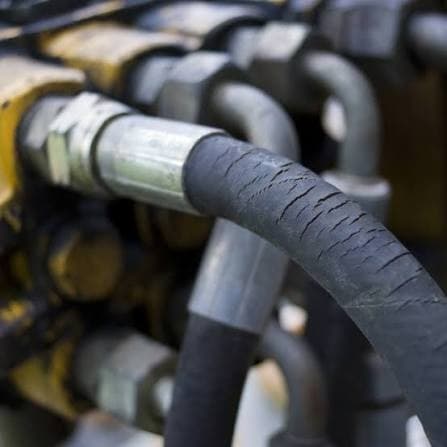
How many years can a hydraulic hose work?
A hose also ages when it looks fine: the rubber loses its elasticity and the bond with the braid weakens. You can check the age of a hose in two places:
- The print on the hose: the manufacturer, the standard (for example EN 853), the type (for example 2SN), the diameter (for example DN 10) and the quarter and year of manufacture of the hose, for example 2Q16, meaning the second quarter of 2016. Before the date, manufacturers usually give the maximum working pressure.
- The ferrule of a finished hose assembly: it is usually stamped with the assembly maker, the maximum working pressure and the year and month of crimping, for example 1606, meaning June 2016.
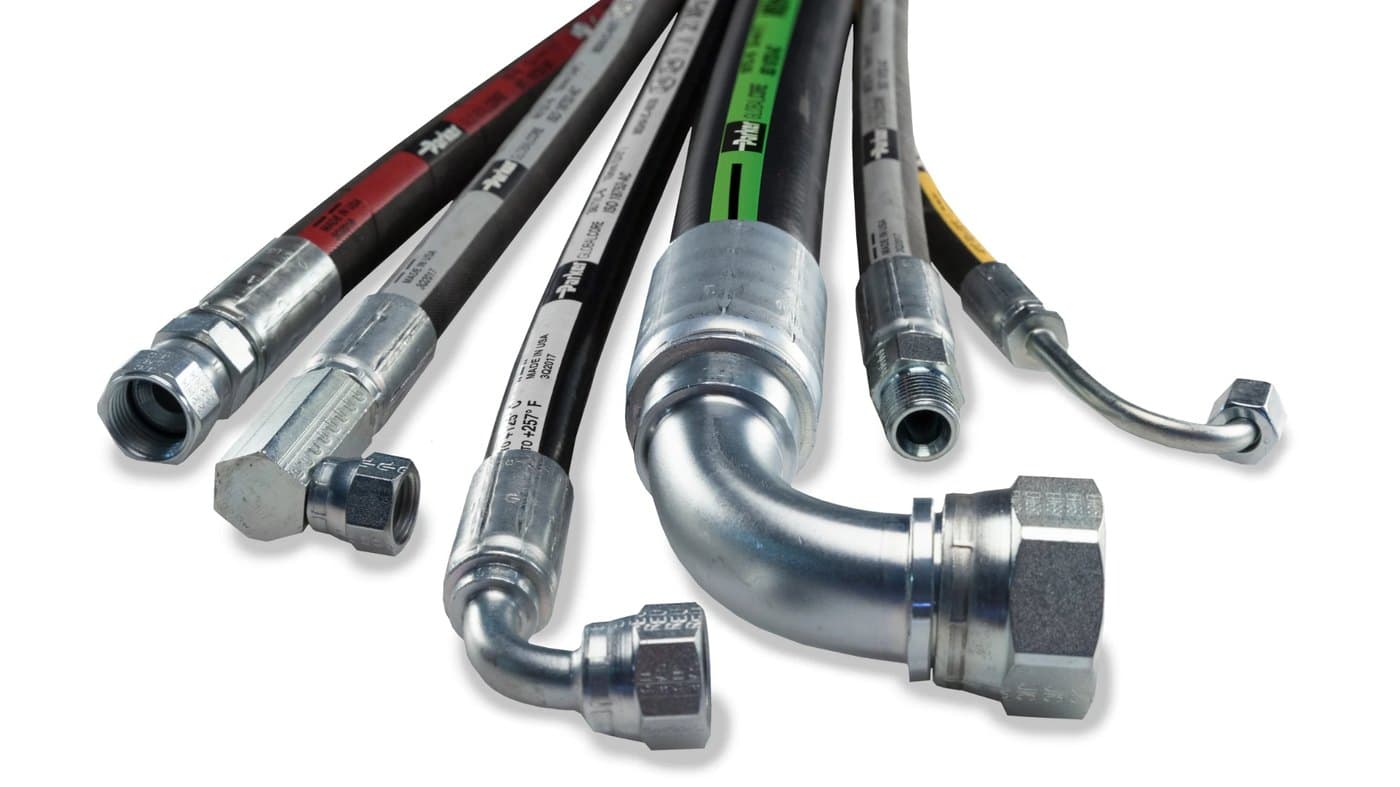
A good point of reference is the German rule DGUV Regel 113-020 (October 2017 edition). It is not a regulation in Poland, but it describes proven practice well:
| Operating conditions of the hose | Recommended replacement |
|---|---|
| Normal | after 6 years, including a maximum of 2 years of storage |
| Increased demands: multi-shift work, short cycles and frequent pressure spikes, strong external influences | after 2 years of service |
The same rule recommends that a hose should be no more than 4 years old at the time of crimping. These periods are a recommendation, not a fixed deadline: the guidelines of the machine and hose manufacturer take priority, and longer service is acceptable only with a documented risk assessment and more frequent inspections. In the other direction there are no exceptions: a hose showing signs of wear is replaced immediately, even if it is only a year old.
A practical tip: when one hose has burst from age, check the others from the same year. They were usually fitted together and are in a similar condition.
What should you do when a hydraulic hose bursts on a lift?
- 1Stop all movements. Release the joystick and do not try to finish the job. With a burst hose the movement can be jerky or may not work at all.
- 2Come down. If the machine allows it, lower the platform with the normal controls. If it does not, use emergency lowering, but only as described in the operator's manual for that machine.
- 3Switch off the engine and cordon off the area. Switch off the drive, remove the key and do not let anyone go under raised parts or into the pool of oil.
- 4Do not look for the leak with your hand. A thin jet of oil under pressure can pierce the skin. Such a wound looks harmless but needs a doctor immediately. You can find the leak by holding a piece of cardboard near it.
- 5Clear up the spilt oil. Cover the spill with absorbent or sand so that the oil does not run into the drains or the ground.
- 6Take photos and call the service team. Photograph both ends of the hose, the markings on the hose and the machine's rating plate. If the hose has already been removed, keep it: it will serve as the pattern for the new hose assembly.
This is a general description: the operator's manual of the specific machine always applies. If the lift is rented from us, call us: we will come, and if the repair cannot be done on site, we will arrange a replacement machine. We have collected the general rules for working on a platform in the article safe work at height.
What does crimping a new hydraulic hose involve?
- 1Matching to the pattern. From the old hose assembly we read the inside diameter (DN), the hose type and its working pressure (for example 2SN to EN 853, a hose with two steel braids), as well as the length, the thread type of the fittings, their angle (straight, 45°, 90°) and their orientation to each other.
- 2Cutting and preparing the hose. The hose is cut to length at a right angle and the inside is cleaned of rubber and metal particles left by the cut.
- 3Crimping the fittings. A ferrule is slid onto the hose, the fitting is pushed in and the whole assembly is squeezed in the press jaws to the diameter given by the fitting manufacturer. The crimped ferrule joins the hose to the fitting permanently.
- 4Inspection and fitting. The crimp diameter is checked, and the hose assembly is fitted in the machine without twisting, keeping the bend radius and using the existing guards.
- 5Leak test and oil. The system is tested under pressure, the hydraulic oil is topped up and only then does the machine go back to work.
This is how we work in the field: the press travels in the service van together with single-braid and multi-braid hoses from DN06 to DN25 and with metric, inch, ORFS, JIC and BSP fittings, both straight and angled. We crimp the new hose assembly at the machine, on the building site or on the company's premises, usually during a single visit if the hose and fittings you need are on the van. Details are on the page hydraulic hose crimping.
How can you make hydraulic hoses last longer?
- A route without friction. A hose must not rub against edges or other hoses; in exposed places fit a spiral wrap or a protective sleeve.
- Bend radius. Do not bend a hose more sharply than the manufacturer allows, and do not bend it right at the fitting.
- No twisting. When fitting, route the hose so that the print runs straight; a twisted hose fails much sooner.
- Spare length. Under pressure a hose changes length slightly, so it must not be as taut as a string.
- Away from heat. The exhaust and the engine speed up the ageing of the rubber; use a heat shield where needed.
- Clean oil. Overheated or contaminated oil destroys a hose from the inside; keep to the oil and filter change intervals.
- Sensible stock. Keep spare hose assemblies in a cool, dark place, away from sunlight and sources of ozone (for example running electric motors), and remember that storage time counts towards the age of the hose.
- Daily operator check. Before work, look at the hoses and at the ground under the machine. Regular maintenance inspections are included in our service packages.
What should you prepare when ordering a new hose assembly?
- the make, model and year of manufacture of the machine (from the rating plate);
- the address where the machine is standing;
- photos of both ends of the hose and of the print on the hose;
- the approximate length of the hose and where in the machine it comes from;
- if the hose has already been removed, the hose itself, because it is the best pattern.
With a report like this we know straight away what to load on the van. Call: or report the breakdown through the form.
Frequently asked questions
Can a burst hydraulic hose be glued or wrapped with tape?
No. Tape, a clamp or glue will not withstand the pressure, which in construction machinery often exceeds 200 bar, and a damaged braid has lost its strength anyway. A makeshift repair can fail at any moment and spray people with hot oil. A damaged hose is replaced with a new hose assembly crimped on a press.
How often should hydraulic hoses be replaced?
A good point of reference is the German rule DGUV 113-020: for normal use it recommends replacement after 6 years, including a maximum of 2 years of storage, and after 2 years for multi-shift work, frequent pressure spikes or strong external influences. This is a recommendation, not a fixed deadline: the guidelines of the machine and hose manufacturer take priority, and a hose showing signs of wear is replaced immediately, regardless of age.
How do I read the production date of a hydraulic hose?
The cover of the hose carries a print with the manufacturer's name, the standard (for example EN 853), the type (for example 2SN), the diameter (for example DN 10) and the quarter and year of manufacture, for example 2Q16, meaning the second quarter of 2016. The ferrule of a finished hose assembly is usually stamped with the assembly maker, the maximum working pressure and the year and month of crimping, for example 1606, meaning June 2016.
Can a hydraulic hose be made on site, without taking the machine to a workshop?
Yes. We arrive in a service van with a crimping press, a stock of hoses from DN06 to DN25 and metric, inch, ORFS, JIC and BSP fittings, and the damaged hose serves as the pattern for the new one. After fitting we test for leaks under pressure and top up the oil. We work in Bydgoszcz and throughout the Kuyavian-Pomeranian Voivodeship; we confirm the arrival time by phone.
What should I do if a hydraulic hose bursts on a lift at height?
Stop all movements and come down with the normal controls or, if that is impossible, by emergency lowering as described in the machine's operator's manual. Then switch off the engine, cordon off the area, do not look for the leak with your hand because a jet of oil under pressure pierces the skin, clear up the oil with absorbent and call the service team with photos of the fittings and the markings on the hose.
Does the hydraulic oil need topping up after a hose is replaced?
Yes. Some oil escapes when a hose bursts and when a hose is replaced, so after fitting the new hose check the level in the tank and top up with the same type of oil that the machine manufacturer requires.
See also
- Mobile hydraulic hose crimping →
- Service for lifts and machines →
- Service packages →
- Hydraulic pumps for machines →
- Safe work at height: the basic rules →
Aerial lift rental costs from PLN 80 + VAT per day: scissor lifts from PLN 80, articulating boom lifts from PLN 160, telescopic boom lifts from PLN 180 (rates for rentals of more than 14 days; shorter rentals have a higher daily rate). Full price list
Request a quote